Cardiff geology
Mercia mudstone under Cardiff homes: ground and cracks
Send details of the crack you have noticed. A specialist firm will read what you describe and tell you whether the ground beneath your home needs further investigation, at no cost to you.
What Mercia mudstone is and where it sits in Cardiff
Much of Cardiff rests on rock laid down during the Triassic period. The Mercia Mudstone Group forms a band running through the city, visible in cuttings and boreholes from the eastern suburbs toward the Vale of Glamorgan. It looks like red or greenish-brown rock when exposed.
This ground is not solid stone all the way through. It contains layers of siltstone, thin beds of gypsum, and pockets of softer material. Builders working on foundations here encounter something that behaves differently from the pure London Clay found further east, or the limestone seen in north Cardiff gardens. Knowing which formation sits below a house matters because each one moves for different reasons.
A [subsidence survey](/methods/subsidence-survey-cardiff) establishes what lies beneath the surface before any repair work begins. Without that information, guessing at the cause of movement leads to wasted effort.
How this ground differs from pure shrinkable clay
Pure clay shrinks when it dries and swells when it gets wet. That cycle opens and closes cracks in walls on a seasonal rhythm. Mercia mudstone does contain clay minerals, so it responds to moisture changes, but the response is slower and less predictable.
The siltstone layers within the mudstone do not shrink. They hold their shape while the clay bands around them move. This means a foundation sitting partly on siltstone and partly on clay can tilt as one side shifts and the other stays put. The differential movement is what cracks brickwork.
Gypsum bands add another problem. Gypsum dissolves slowly in groundwater. Over decades, water flowing through the rock can wash out these bands, leaving small voids. A house built above a void will settle into it. If you suspect this, [foundation repair](/methods/foundation-repair-cardiff) specialists use boreholes and probes to find where the ground has been lost.
Why walls crack above mudstone foundations
Cracks caused by mudstone movement tend to follow the mortar joints in brickwork. They often appear near corners or above window openings, where the wall is weakest. A diagonal crack stepping down through several courses of bricks usually points to one side of the foundation dropping lower than the other.
Seasonal changes still play a part. Wet winters soften the clay bands; dry summers stiffen them. But because the rock also contains rigid layers, the cracking pattern does not always close up neatly when the weather turns. Once a wall has moved far enough to break the bond between bricks, it rarely returns to its original position on its own.
If a crack appears suddenly after heavy rain, a leaking drain might be washing soil away rather than the rock itself moving. Checking for [drain-related subsidence](/ground/leaking-drain-subsidence) rules out a simpler explanation before anyone assumes the mudstone is to blame.
Trees, roots and the moisture balance in the rock
Large trees extract significant amounts of water from the ground. On pure clay, this causes rapid shrinkage. On Mercia mudstone, the effect depends on how much clay the local rock contains. A mature oak standing close to a house can still draw enough moisture from the clay bands to trigger settlement.
The roots themselves rarely break through solid siltstone. They follow the softer clay seams and any fractures already present in the rock. So a tree planted over a fault line in the mudstone may cause more damage than one growing in a uniform bed.
Before removing a tree to stop movement, consider that felling it allows moisture to return to the ground quickly. The clay swells, and the foundation heaves upward. Managing [trees near foundations](/ground/trees-near-foundations) requires understanding both the species and the exact ground conditions.
Finding out what is actually happening below your home
Watching a crack over several months tells you whether it is still moving. Simple monitoring with tell-tales or glass gauges records the direction and speed of movement. Structural [crack monitoring](/methods/structural-monitoring-cardiff) gives a clearer picture than a single photograph taken on the day you first noticed the problem.
If monitoring shows continued movement, the next step is investigating the ground. Trial pits dug beside the foundation reveal the depth of the footing and the type of rock directly below it. Boreholes go deeper, showing whether voids or dissolved gypsum exist further down.
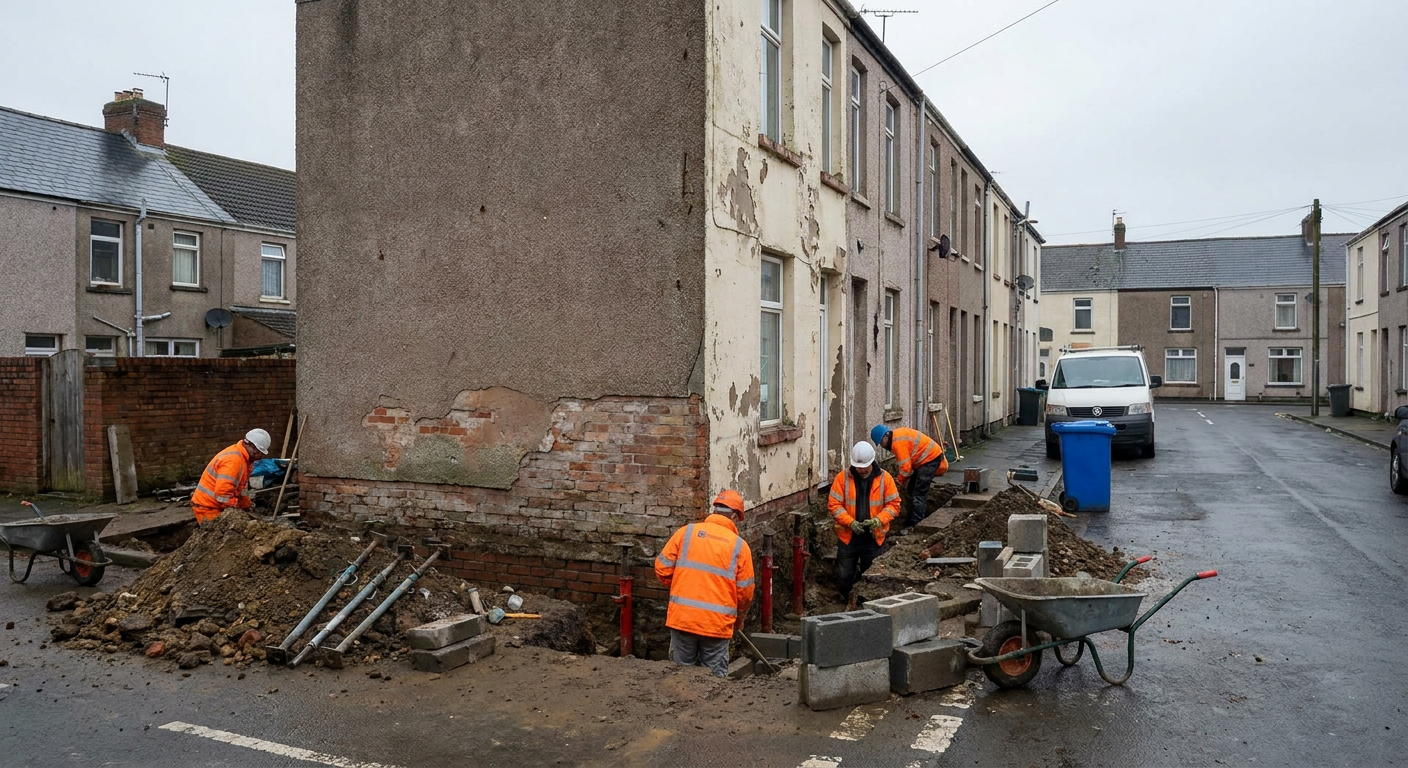
The results determine the repair method. Where the existing foundation is simply too shallow for the mudstone, [mass concrete underpinning](/methods/mass-concrete-underpinning-cardiff) extends it to a stable depth. Where the problem goes deeper, [mini-piled underpinning](/methods/mini-piled-underpinning-cardiff) transfers the load past the weak rock entirely.
Repair methods suited to mudstone conditions
Mudstone demands specific approaches. Pouring concrete into a trench only works if the base of that trench sits on material that will not dissolve or shift later. Specialist contractors check the bearing capacity of the exposed rock before committing to a pour.
Where voids have formed because of gypsum dissolution, injecting resin can fill the gaps and bind loose material together. [Resin injection](/methods/resin-injection-cardiff) stabilises the ground without excavating large trenches, which is useful in confined spaces or where access is restricted.
For houses with basements cut into the mudstone, lowering the floor level requires care. The rock may look solid when dry but soften once exposed to air and water during excavation. [Basement underpinning](/methods/basement-underpinning-cardiff) in these conditions follows a strict sequence to prevent the surrounding walls from losing support mid-project.
Choosing the right approach depends entirely on what the investigation finds. No two sites on Mercia mudstone behave identically, so the repair must match the specific ground profile beneath your home.
Ask about the ground beneath your home
Send a description of the crack or movement you have seen. A specialist firm will review the details and advise whether the ground needs investigation, with no obligation to proceed.
- No charge for advice
- No commitment required
- Local ground knowledge