Cardiff
Types of underpinning explained, method by method
Send a description of the problem you have noticed. A specialist firm will read it and tell you what to do next, without charging you for that first conversation.
Finding out if your home is subsiding
A crack in a wall does not always mean the ground beneath your home has moved. Plaster dries out, timber shrinks, and old brickwork settles over decades. But when a gap opens wider than a few millimetres, or runs diagonally from a window corner toward the ceiling, the foundations may be shifting.
A subsidence survey establishes whether movement is active. The specialist firm inspects the walls inside and out, checks the soil type, and looks for drains that might be leaking water into the ground. In Cardiff, the geology changes street by street. Limestone sits under parts of the north, while made ground from old docks lies near the bay. Each behaves differently when it gets wet or dry.
Find out how a [subsidence survey spots the signs in your home](/methods/subsidence-survey-cardiff). If you are buying a place and the paperwork already mentions movement, there is specific advice on what a [survey mentioning subsidence means for buyers](/ground/survey-mentions-subsidence).
Repairing cracks before they spread
Once the cause of movement is known, the cracks themselves need attention. Filling them with standard decorator filler hides the problem. Structural crack repair uses materials that bond with the masonry so the wall regains its strength.
The specialist firm stitches across the fracture using steel bars set into resin, or replaces damaged bricks where stitching will not hold. They also determine which cracks need structural work and which are cosmetic. A hairline line above a door frame after a dry summer might close up on its own once the rain returns. A gap you can fit a coin into rarely does.
Learn more about [crack repair and which fractures need structural work](/methods/crack-repair-cardiff). You can also start by checking whether a [wall crack is getting bigger over time](/ground/how-to-monitor-a-crack) using a simple gauge you fix across the opening yourself.
Strengthening shallow foundations
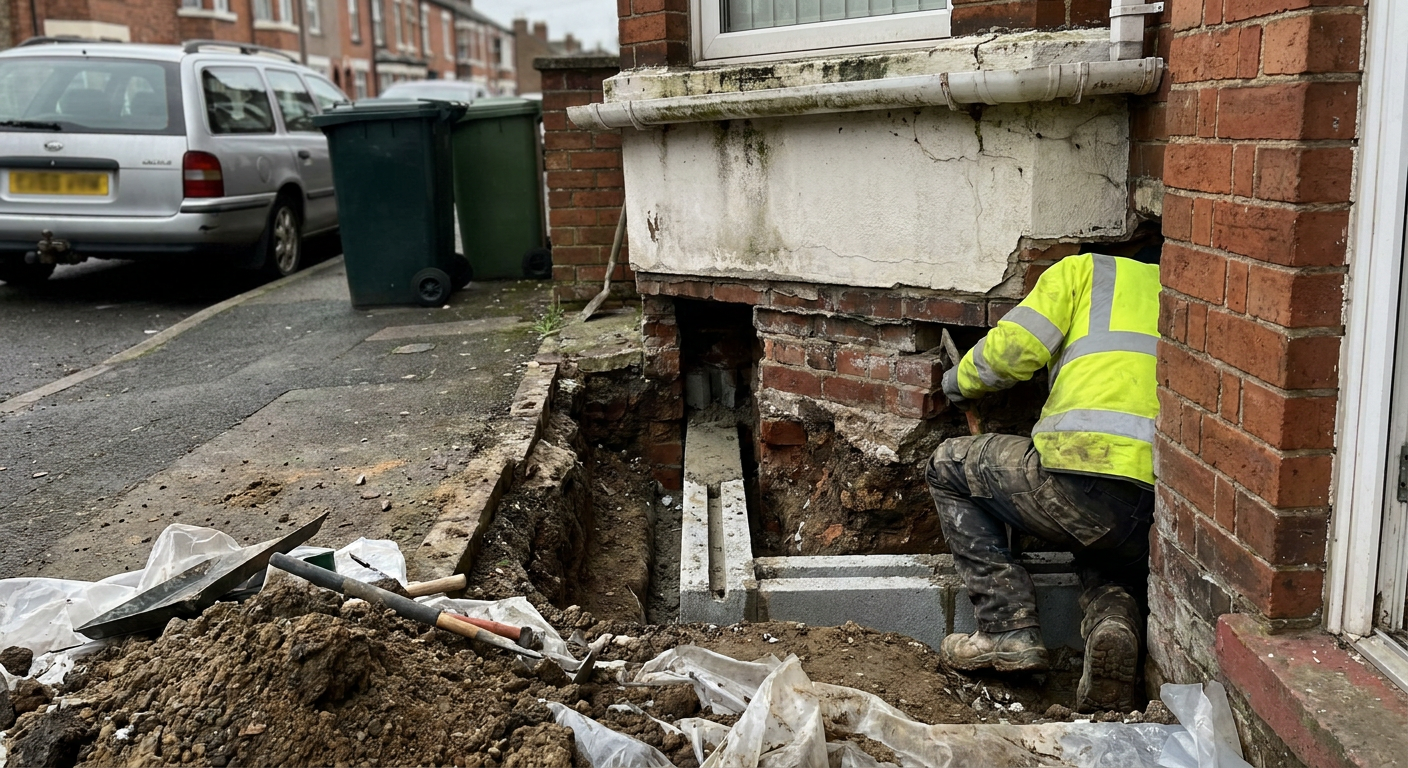
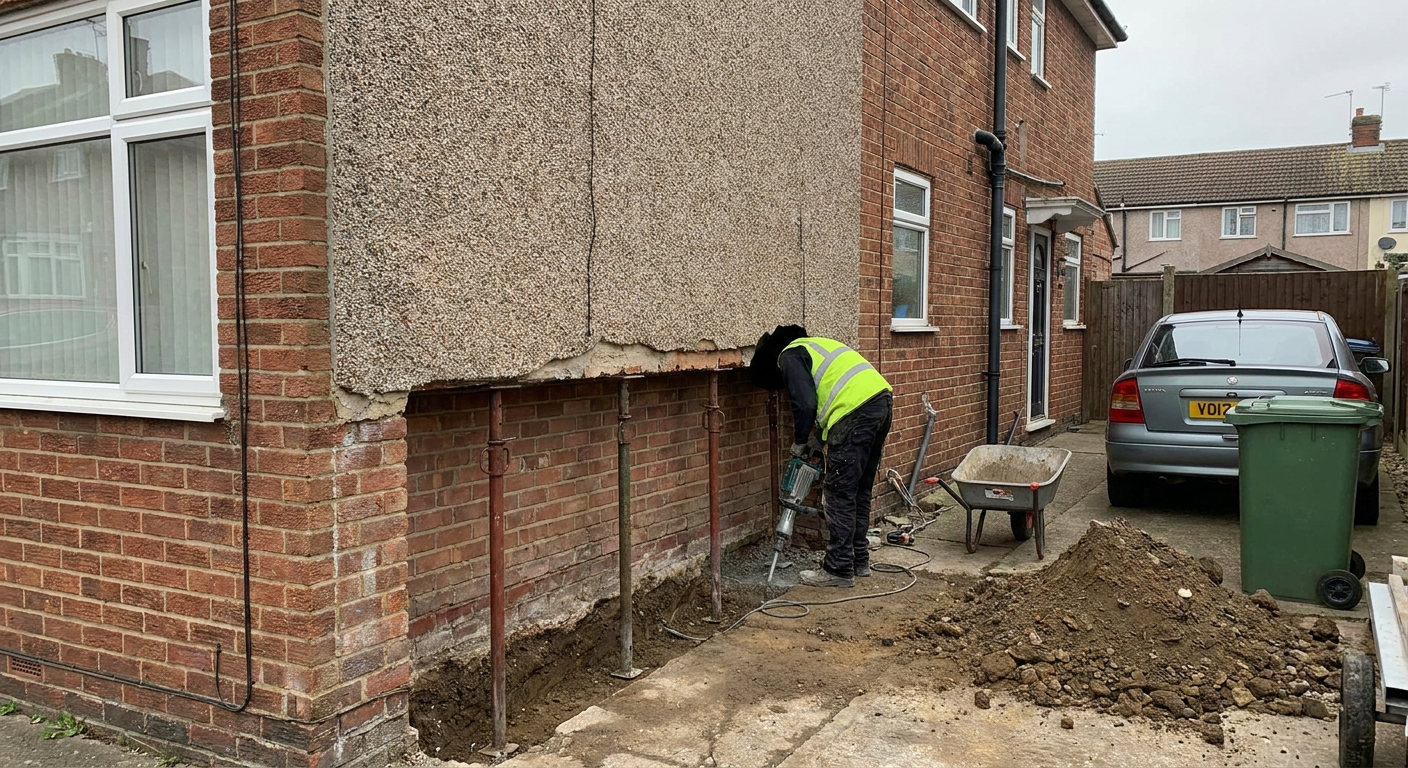
When the soil under a house cannot support the weight of the walls above it, the foundations need to go deeper or wider. Mass concrete underpinning is the oldest method. The specialist firm digs out sections of earth below the existing footing in short bays, then fills each void with concrete. Once it cures, they move to the next bay until the whole wall rests on new, deeper footings.
This method suits homes where stable ground sits just a metre or two below the current foundation level. It is heavy work and requires careful sequencing so the wall does not drop while the soil is removed.
Read how [mass concrete underpinning is done](/methods/mass-concrete-underpinning-cardiff) step by step. For a broader view of fixing movement under walls, see the notes on [foundation repair](/methods/foundation-repair-cardiff).
Reaching stable ground far below
In some parts of Cardiff, the load-bearing strata lie several metres down. Digging a trench that deep beside a house risks collapsing the ground entirely. Mini piled underpinning solves this. The specialist firm drives or drills narrow steel-cased piles through the weak soil until they reach rock or firm clay. A reinforced concrete beam is then cast across the pile heads to carry the wall.
This approach causes less vibration than mass concrete and works where access is tight, such as terraced streets in Canton or Pontcanna. It also suits homes built on fill material that was never compacted properly.
Find out more about [mini piled underpinning for deep foundation fixes](/methods/mini-piled-underpinning-cardiff). The depth required depends entirely on what lies beneath your specific street, which is why a survey must come first.
Watching movement over months
Sometimes the right action is to wait. If a crack appeared after an unusually dry spell, the ground may swell back once winter rains arrive. Structural monitoring tracks whether a wall is still moving or has settled.
The specialist firm fixes small gauges across the cracks and records readings at set intervals. These measurements show whether the gap is widening, closing, or staying still. Without this data, any repair might fail because the underlying movement has not stopped.
Monitoring also provides evidence for insurance claims. Buildings insurers in the UK typically ask for proof that subsidence is ongoing before they authorise major works. Read about [structural monitoring and tracking movement over time](/methods/structural-monitoring-cardiff), and check whether [cracks tend to worsen in cold weather](/ground/cracks-in-winter) due to frost action on saturated masonry.
Stabilising soil without digging
Resin injection offers an alternative to excavation. The specialist firm pumps a two-part polyurethane resin into the ground beneath the foundations through small drilled holes. The liquid expands as it cures, compacting loose soil and lifting settled concrete slabs or footings back toward their original level.
This method suits situations where access for diggers is impossible, or where the homeowner wants to avoid the disruption of open trenches. It works best in granular soils and made ground rather than stiff clays that shrink and swell seasonally.
See how [resin injection stabilises the ground below a home](/methods/resin-injection-cardiff). The choice between resin and traditional underpinning depends on the soil report and the scale of movement recorded during monitoring.
Creating space below an existing floor
Basement underpinning strengthens the foundations while lowering the floor level to create a habitable room. The specialist firm removes the existing cellar floor in controlled stages, excavates deeper, and pours new concrete walls and slabs that tie into the original footings.
This is complex work. It requires temporary propping of the house above, waterproofing membranes, and building control approval. In Cardiff, Victorian terraces with shallow cellars are common candidates, but the proximity of neighbouring properties means the sequence of digging must protect shared party walls.
Read about [lowering basement floors safely](/methods/basement-underpinning-cardiff). Before any work begins, the contractor must notify adjoining owners under the Party Wall Act, which applies throughout Wales and England.
Choosing who carries out the work
Underpinning is permanent structural alteration. The firm that does it must understand local ground conditions, building regulations, and the limits of each method. Underpinning contractors in Cardiff range from large national companies to smaller regional specialists.
What matters is that they base their proposal on a proper investigation rather than a single site visit. They should explain why they chose one method over another, provide calculations for the new foundation depths, and arrange building control inspections at each stage.
Find out [how to choose underpinning contractors](/methods/underpinning-contractors-cardiff) and what questions to ask before signing anything. You can also read about [what drives the cost of underpinning](/ground/what-drives-underpinning-cost) so the figures on a quote make sense. Work in nearby areas like [Penarth](/penarth) or [Dinas Powys](/dinas-powys) follows the same principles but often encounters different soil types.
Tell us what you have found in your home
Write down where the crack is and how wide it looks. A specialist firm will review the details and reply with plain advice. Sending this does not commit you to any work or payment.
- No obligation to proceed
- Free initial assessment
- Local ground knowledge
Methods
- Subsidence survey
A subsidence survey in Cardiff sets out what is moving and why, covering crack patterns, drains, clay soils and trees, and what the report covers.
- Mass concrete
Mass concrete underpinning in Cardiff deepens shallow foundations in bays. See where this traditional method suits a house and what the work involves.
- Crack repair
Crack repair in Cardiff covers stitching, repointing and resin work. Check which cracks are cosmetic and which point to foundation movement.
- Mini Piled
Mini piled underpinning in Cardiff suits homes where foundations sit on weak or deep ground, or where access is tight. See how the piles work.
- Monitoring
Crack monitoring in Cardiff uses gauges and readings taken over months to show whether a crack is still moving and what that means for repairs.
- Basement Underpinning
Basement underpinning in Cardiff lowers and deepens foundations to make cellar space usable. Read what the work involves and which homes it suits.
- Resin Injection
Resin injection in Cardiff firms up loose or shrinking ground under a foundation without deep digging. Find out where it helps and where it does not.
- Contractors
Underpinning contractors in Cardiff work on homes with foundation movement. Find what a quote should cover, how access is planned and what to ask first.
- House underpinning
Underpinning for a subsiding house in Cardiff supports foundations that have moved. Find out what the signs are and how the work is planned.
- Foundation repair
Foundation repair in Cardiff deals with walls and floors affected by ground movement. Learn which repairs are used and when a survey comes first.