Cardiff gardens
Tree too close to house foundations: what to do
Send details of the crack or movement you have noticed. A specialist firm will read them and explain what usually happens next, without charging for that first look.
Trees near house foundations in Cardiff
How close is too close for a mature tree?
A common question from owners eyeing a large tree in or next to the garden is how close is too close for a mature tree to a house in Cardiff. The answer depends on the ground beneath the footings. Much of the city sits on clay, which shrinks when it dries out and swells when it gets wet. A tree draws moisture through its roots, so the distance trees from house walls needs to account for both the species and the soil type.
On shrinkable clay, roots can affect foundations at a greater distance than on sand or gravel. Which trees cause the most trouble near foundations, and is mine one of them? Willows, poplars and oaks are known for high water demand. Their roots spread widely to find moisture. If your home stands on clay soil, trees and shrinkage become linked concerns during dry summers. A [subsidence survey](/methods/subsidence-survey-cardiff) establishes whether the ground movement matches root activity or points to something else entirely.
Root spread compared with tree height
People often picture roots dropping straight down. In reality, most fine roots sit within the top metre of soil and extend horizontally. How far do roots actually spread compared with the height of the tree? For many broadleaf species, the root system reaches one to two times the canopy width. On heavy clay, they travel further because moisture is harder to extract.
Tree roots damaging foundations is not always a matter of physical pressure against brickwork. The more frequent mechanism on Cardiff clay is moisture extraction. As the soil dries, it loses volume and the footing settles unevenly. This seasonal drying causes cracks that open in summer and narrow in winter. Monitoring that movement over several months helps a specialist firm separate normal thermal shifts from subsidence driven by vegetation.
Neighbour trees and legal boundaries
If a neighbour's tree overhangs your garden, you might wonder whether you can ask for it to be cut back. Neighbour tree roots in Cardiff follow the same rules as any boundary dispute: you generally have the right to prune branches back to the property line, but the law around roots is less straightforward. Cutting roots without advice risks destabilising the tree, which could make it fall.
Before pruning anything, check for tree preservation order restrictions. Cardiff council maintains a register of protected trees. Pruning or felling a tree covered by an order without permission is an offence. Even if no order exists, removing a large tree suddenly changes the moisture balance in the ground. Specialist firms carry out tree preservation order checks before recommending any work near a home's foundations.
Felling a tree and the risk of heave
Removing a tree seems like the obvious fix, but felling can cause problems of its own. If I fell the tree, could the ground swell and make things worse? On shrinkable clay, the answer is yes. Once the roots stop extracting water, the soil reabsorbs moisture and expands. This upward movement is called heave after tree removal, and it can push foundations higher than their original level.
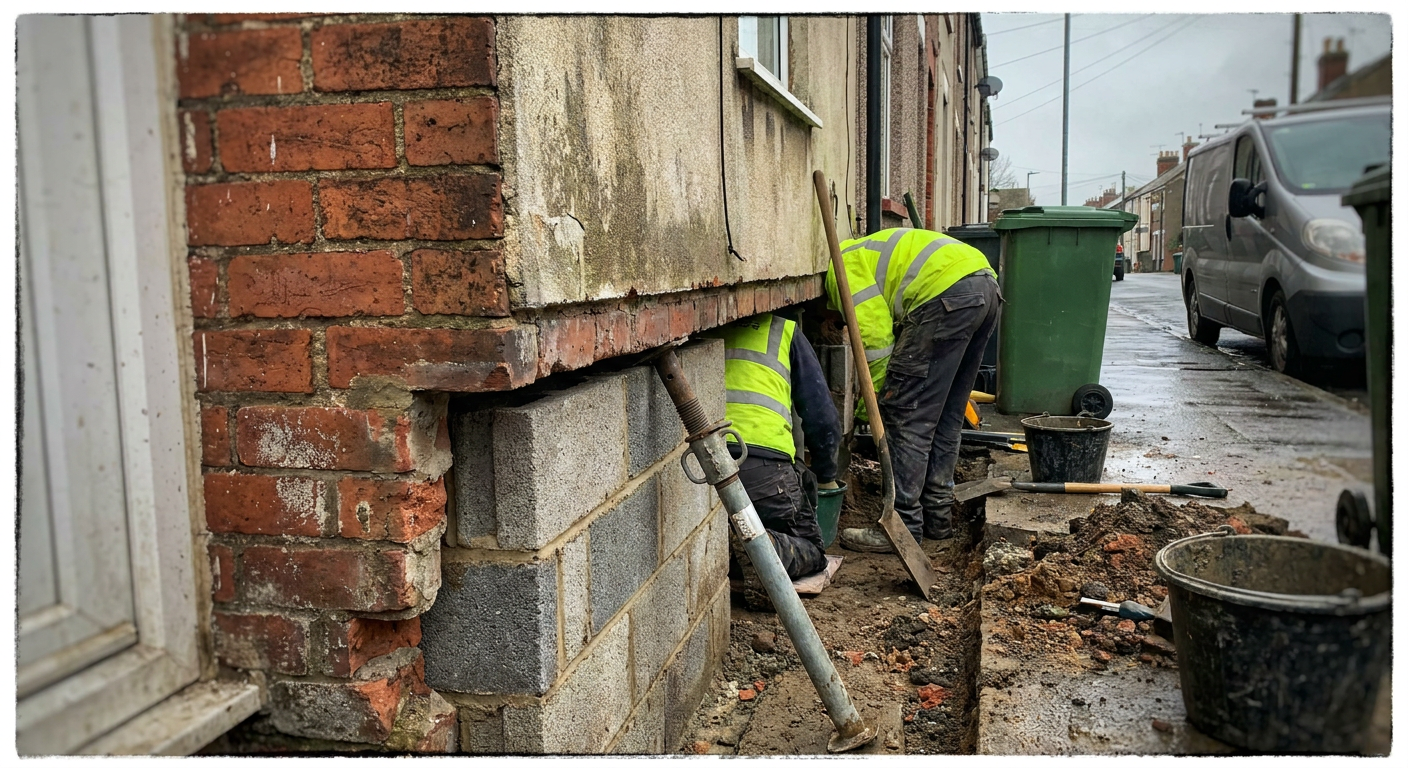
Heave sometimes causes more damage than the original subsidence. A specialist firm will assess whether gradual crown reduction is safer than complete felling. Reducing the leaf area slowly lowers water uptake without shocking the ground. Where heave has already started, methods such as [mass concrete underpinning](/methods/mass-concrete-underpinning-cardiff) or [mini piled underpinning](/methods/mini-piled-underpinning-cardiff) may be needed to stabilise the wall at a depth below the active clay layer.
Is it the tree or a leaking drain?
Cracks near a large tree do not automatically mean the tree is to blame. Is the tree likely to be the cause, or could it be the drains instead? A fractured pipe washes fine particles from the soil, creating voids that allow footings to drop. The resulting cracks look identical to those caused by root-induced clay shrinkage.
A thorough investigation rules out plumbing faults before pointing at vegetation. Drain testing and trial holes let a specialist firm see the soil condition directly beneath the wall. If the drain is leaking, fixing it stops the movement. If the clay is desiccated and roots are present, the remedy involves managing the tree and possibly repairing the foundation. Either way, guessing saves nothing; inspection settles it.
Can a specialist confirm roots under footings?
You cannot see what lies beneath a concrete strip without digging. Can a specialist tell whether roots are under my footings? Yes. Trial pits dug alongside the wall expose the soil profile and reveal root penetration. Soil samples taken at different depths show moisture content, confirming whether the clay is actively shrinking.
Once the cause is established, the specialist firm decides on the repair. Sometimes [crack repair](/methods/crack-repair-cardiff) alone is enough if the movement has stopped. Where ongoing settlement threatens the structure, [resin injection](/methods/resin-injection-cardiff) can consolidate loose ground, or [structural monitoring](/methods/structural-monitoring-cardiff) tracks the wall over a season to prove stability before any major work begins.
Reading the signs around your home
The same crack pattern can point to root activity, a broken drain or simple thermal movement. Only an inspection separates these causes reliably.
- Diagonal crack wider at the top
- Often indicates one end of the wall settling faster than the other. A survey determines if roots or drains are responsible.
- Cracks opening in summer, closing in winter
- This pattern usually points to seasonal clay shrinkage, where trees draw moisture from the soil during dry months. A subsidence survey establishes whether roots are involved or if another factor is causing the ground to move.
- Doors sticking on one side only
- Readings like this typically point to localised frame distortion caused by uneven ground movement beneath the walls. Inspecting nearby drains and checking for tree roots helps a specialist narrow down the actual cause.
- Gaps between skirting boards and the floor
- Floor joists or slabs moving independently of the wall. Root activity or soil washout both produce this sign.
- New cracks near a recently felled tree
- This often points to heave, which happens when clay rehydrates and swells after a tree is removed or felled. Measuring crack width over several weeks shows whether the movement has stopped or is continuing.
Typical costs for foundation and tree-related work
Prices vary because every home sits on different ground. Access, depth of footings and the chosen method all shift where a job falls within these ranges. The figures below reflect typical work across Cardiff.
-
Crack stitching and cosmetic repair
£800 - £2,500
Number of cracks and whether internal plaster finishes need reinstatement afterwards.
-
Structural crack monitoring setup
£400 - £1,200
How many gauges the specialist installs and the length of the reporting period.
-
Drain survey and leak repair
£1,500 - £4,000
Depth of the pipe, access for excavation and whether relining or replacement is required.
-
Resin injection ground treatment
£3,000 - £8,000
Area affected and how deep the resin must penetrate to reach stable strata.
-
Mass concrete underpinning per metre
£1,500 - £3,500
Depth to competent ground and whether party wall agreements slow the sequence.
-
Mini piled underpinning per metre
£2,000 - £5,000
Pile depth required to bypass soft clay and reach load-bearing layers below.
These indicate what work of this type typically costs. Nothing here is a quotation. Only an inspection of your home settles a figure.
Tell us what you have noticed
Describe the crack or movement. A specialist firm reviews the details and explains the likely next steps. Sending an enquiry does not commit you to any work or cost.
- No obligation
- Free initial review
- Local specialists